LOGICAL RELATIONSHIP | TRANSITIONAL EXPRESSION |
| Similarity | also, in the same way, just as ... so too, likewise, similarly |
| Exception/Contrast | but, however, in spite of, on the one hand ... on the other hand, nevertheless, nonetheless, notwithstanding, in contrast, on the contrary, still, yet |
| Sequence/Order | first, second, third, ... next, then, finally |
| Time | after, afterward, at last, before, currently, during, earlier, immediately, later, meanwhile, now, recently, simultaneously, subsequently, then |
| Example | for example, for instance, namely, specifically, to illustrate |
| Emphasis | even, indeed, in fact, of course, truly |
| Place/Position | above, adjacent, below, beyond, here, in front, in back, nearby, there |
| Cause and Effect | accordingly, consequently, hence, so, therefore, thus |
| Additional Support or Evidence | additionally, again, also, and, as well, besides, equally important, further, furthermore, in addition, moreover, then |
| Conclusion/Summary | finally, in a word, in brief, briefly, in conclusion, in the end, in the final analysis, on the whole, thus, to conclude, to summarize, in sum, to sum up, in summary |
Thursday, November 4, 2010
Transition Words II

Wednesday, November 3, 2010
Finding Information Here

Look at the Blog Archive for posts on various subjects. Click on the arrow by a month to see all posts for that month.
You could use the search bar at the upper left to look for particular subjects.
On blogs, newer posts appear at the top, so as you scroll down, you are reading older posts.
Another useful item is the calendar in the margin at the right. Some of the events provide more information when you click on them. A-Days are marked because that is the day we meet in our English classes.
FYI: You can access the district calendar on the district website or here.
Topic Sentences
Formula for a topic sentence:
An interesting subject
+ your specific feeling about it
___________________________
= a good topic sentence
 |
| Formula? |
+ your specific feeling about it
___________________________
= a good topic sentence
November 10, 2010
Bell-Ringer: Finish pages 6 and 7 if needed and complete pages 8 and 9.
Correct
Perfect Paragraph Packet.pdf
Reading Minutes:
A1 Shadowland by Meg Cabot and Found by Haddix
A2 Fablehaven: Keys to the Demon Prison by Brandon Mull
Princess Academy by Shannon Hale
A3 The Sisters Grimm by Michael Buckley
A4 Dragon Slippers by Jessica Day George
Book-of-the-Month assignment. See the tab above.
Spelling -- Word Sort
History of the English Language:
Correct
Perfect Paragraph Packet.pdf
Reading Minutes:
A1 Shadowland by Meg Cabot and Found by Haddix
A2 Fablehaven: Keys to the Demon Prison by Brandon Mull
Princess Academy by Shannon Hale
A3 The Sisters Grimm by Michael Buckley
A4 Dragon Slippers by Jessica Day George
Book-of-the-Month assignment. See the tab above.
Spelling -- Word Sort
History of the English Language:
A1 through Spanish
A2 needs Spanish
A3 needs Spanish
A4 needs Spanish and sample words
November 8, 2010
Bell-Ringer: Paragraph Packet -- Complete pages 4, 5, 6, and 7. Notice that pages 6 and 7 go together. Page 7 is the sentence bank mentioned in the directions on page 6. Perfect Paragraph Packet.pdf
Reading Minutes:
A1 -- none
A2 -- none
A3 -- The Candy Shop War by Brandon Mull
A4 -- none
Spelling:
A3 receives copies of -able, -ible assignment.
All students: Study your spelling a little every day.
If you are absent, or lose your handout, see this blog for the spelling assignment. For this week you can find it here: -able/-ible for spelling test
audible -- as in audio, auditorium, audition
visible -- as in vision, video
Extra credit: According to word parts, what does portable mean? Look it up.
You could try http://dictionary.reference.com/browse/portable
See the entry from the World English Dictionary.
Reminders:
If you don't have the packet, you need to get one, and catch up on pages 1, 2, and 3.
Perfect Paragraph Packet.pdf
Extra Credit: What does mean? See the nswer below. Be the first to tell me for 5 points extra credit.
Reading Minutes:
A1 -- none
A2 -- none
A3 -- The Candy Shop War by Brandon Mull
A4 -- none
Spelling:
A3 receives copies of -able, -ible assignment.
All students: Study your spelling a little every day.
If you are absent, or lose your handout, see this blog for the spelling assignment. For this week you can find it here: -able/-ible for spelling test
Legibility/correct formation of letters counts! Capitalize only letters that should be capitalized.
audible -- as in audio, auditorium, audition
visible -- as in vision, video
Extra credit: According to word parts, what does portable mean? Look it up.
You could try http://dictionary.reference.com/browse/portable
See the entry from the World English Dictionary.
More of the History of Our Language.
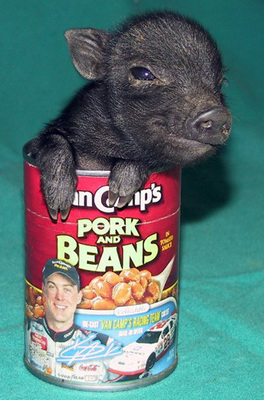 |
| Can you tell why we use the words "pig" and "pork" as we do? |
History of the English Language PowerPoint
Cloze Notes for History of the English Language PowerPoint
And the Spanish Language, too!
Reminders:
If you don't have the packet, you need to get one, and catch up on pages 1, 2, and 3.
Perfect Paragraph Packet.pdf
Extra Credit: What does mean? See the nswer below. Be the first to tell me for 5 points extra credit.
November 4, 2010
1. Bell-Ringer: Finish your paragraph comparing the book and movie of The Outsiders, if needed. Revise and edit. Check to make sure you have all the parts of the hamburger there.
Receive packet for "The Perfect Paragraph." Perfect Paragraph Packet.pdf
Write your name and period on the front of the paragraph packet you receive.
Then
a. Carefully read page 1 about creating paragraphs.
b. Complete pages 2 and 3. Creating outlines for paragraphs.
2. Spelling test on bi- and words using this prefix -- with meanings.
Receive handout for -able, -ible words.
3. Reading Minute:
A1: Once Upon a Marigold -- Jean Ferris
A2: Rascal -- Sterling North
A3: Tennis Shoes Among the Nephites -- Chris Heimerdinger
A4: Confetti Girl -- Diana Lopez
4. Watch the PowerPoint and fill in "cloze" notes about the history of our language.
Your word part for next time includes two suffixes that mean the same thing:
See this post for more information on the test:
extra credit:
Be the first to tell me how we got the word "television, including what languages the word parts come from, and get 6 extra credit points. See below:
Receive packet for "The Perfect Paragraph." Perfect Paragraph Packet.pdf
Write your name and period on the front of the paragraph packet you receive.
Then
a. Carefully read page 1 about creating paragraphs.
b. Complete pages 2 and 3. Creating outlines for paragraphs.
2. Spelling test on bi- and words using this prefix -- with meanings.
Receive handout for -able, -ible words.
3. Reading Minute:
A1: Once Upon a Marigold -- Jean Ferris
A2: Rascal -- Sterling North
A3: Tennis Shoes Among the Nephites -- Chris Heimerdinger
A4: Confetti Girl -- Diana Lopez
4. Watch the PowerPoint and fill in "cloze" notes about the history of our language.
History of the English Language PowerPoint
Cloze Notes for History of the English Language PowerPoint
A1 to the Vocabulary Sources
A2 to the Vocabulary Sources
A3 to the Vocabulary Sources
A4 to "pig and pork"
______________________________
Your word part for next time includes two suffixes that mean the same thing:
Suffix | Meaning | Examples |
-able | capable of (adjective) | capable, agreeable, expandable, remarkable |
-ible | edible, visible, audible, legible, tangible |
See this post for more information on the test:
-able/-ible for spelling test
_____________________________________________extra credit:
Be the first to tell me how we got the word "television, including what languages the word parts come from, and get 6 extra credit points. See below:
-able/-ible for spelling test
Remember that there are no retakes on these tests.
Vocabulary/Spelling #2 Test on November 18
Vocabulary/Spelling #2 Test on November 18
Suffixes to study: -able and -ible which both mean capable of
and are used to create adjectives.
Words to learn for the spelling test:
1. agreeable 3. edible
2. expandable 4. visible
5. audible
You are responsible for learning the suffix and the spelling words.
Here is an effective method for studying your spelling words:
1. Read the first word: look at it and say it.
2. Spell the word to yourself: touch each letter with your pencil and say the letter softly aloud to yourself.
3. Close your eyes. See the word in your mind. Say each of the individual letters softly aloud to yourself.
4. Now, put your memory muscle to work. Carefully print the word in the next three columns, and say each of the individual letters to yourself as you write it.
5. Take a break of four or five minutes to give your long-term memory time to process the look of the word, its letters, and their order. Leave behind your spelling and do something else for those minutes: read, do other homework, watch TV, listen to the radio.
6. Then cover the correct spelling with your hand and print the word in the "Spell" column.
7. Proofread: check the word you just wrote letter for letter against the original, using the tip of your pencil.
8. If you spelled the word correctly, put a star in the final column and go on to the next word on the word study sheet. If you misspelled it, repeat the process above, steps 1-6, this time printing the word in the "Spell Again" column.
9. Repeat the procedure with each remaining word. Again, the study process for five words should take about twenty minutes.
*Do not capitalize these words.
Word | Write the Word | Write the Word | Write the Word | Spell | Spell Again |
agreeable | |||||
expandable | |||||
edible | |||||
visible | |||||
audible |
Extra Credit: Be able to tell what part of speech each of these is. Hints: They are all the same part of speech. What part of speech do -able and –ible make?
edible means “capable of being eaten”
visible means “capable of being seen” (extra credit -- Related words include vision and video.)
audible means “capable of being heard” (extra credit -- Related words include audience and audio.)
Subscribe to:
Posts (Atom)